Commercial popcorn machine capacity is determined by more than kettle size or heating power. The actual output depends on the popping cycle, heating technology, kernel quality, machine configuration, operator workflow, and the capacity of downstream processes such as cooling, coating, and packaging.
For a popcorn shop or cinema, capacity usually means how many batches a machine can produce during busy hours. For a popcorn factory, it is more useful to measure output in kilograms per hour (kg/h). Understanding the difference helps buyers select equipment that matches their production targets without paying for unnecessary capacity.
XFD offers commercial popcorn machines and industrial popcorn production lines for different business requirements. The key is to match the equipment configuration to the required output, product type, and operating conditions.
What Determines Commercial Popcorn Machine Capacity?
The main factors affecting commercial popcorn machine capacity are kettle size, popping cycle time, heating technology, kernel popping performance, machine quantity, and production-line efficiency. For industrial equipment, the speed of cooling, seasoning, and packaging also affects how much finished popcorn a factory can produce.
For example, a machine may have a large kettle but still deliver lower hourly output if its heating cycle is slow or the operator needs considerable time to unload and reload each batch. Likewise, a fast popping machine cannot achieve its full potential if the downstream coating or packaging equipment becomes a bottleneck.
Before comparing machines, buyers should establish whether they need batch output for a retail location or continuous, coordinated production for a factory. These applications require different capacity calculations and equipment configurations.
Kettle Size and Popping Cycle Time
Kettle size is one of the most visible factors affecting the output of a commercial popcorn machine. A larger kettle can generally process more kernels per batch, provided the machine is designed to heat and agitate that load effectively.
However, kettle size alone does not determine hourly production. Buyers also need to consider how long each batch takes, including heating, popping, unloading, and preparing the kettle for the next cycle.
A useful estimate is:
Estimated hourly output = finished popcorn per batch × completed batches per hour
For example, if a machine produces 2 kg of finished popcorn per batch and completes 10 batches per hour, its estimated output is 20 kg/h. This is an illustrative calculation, not a specification for a particular XFD model. Actual output depends on the machine, recipe, batch loading, and operating conditions.
When evaluating commercial and cinema popcorn machines, compare the kettle capacity and complete operating cycle rather than selecting equipment based only on its advertised kettle size.
Heating Technology and Heat Transfer Efficiency
Heating technology affects how quickly the kettle reaches the required temperature and how consistently it can maintain suitable popping conditions. Faster, more controllable heating can help shorten the production cycle, although the result depends on the complete machine design.
Traditional electric heating and electromagnetic heating are two options used in commercial popcorn equipment. Their performance should be compared using actual cycle times, energy requirements, control features, and finished-product quality.
XFD's electromagnetic popcorn production equipment uses electromagnetic heating technology. The company lists certain configurations with a popping cycle of approximately three minutes per kettle, compared with around five to six minutes for traditional configurations. These figures apply to the specified equipment and operating conditions; they should not be assumed for every machine.

Heating technology, kettle configuration, and the overall production cycle all influence commercial popcorn machine output.
For factories comparing different heating technologies, the industrial popcorn machine range provides a starting point for evaluating production-line options. The appropriate choice depends on the required output, popcorn variety, energy supply, and level of automation.
Kernel Quality, Moisture, and Popping Performance
The raw materials also affect popcorn machine capacity. Even a well-designed machine cannot consistently deliver its expected output if the kernels have unsuitable moisture content, inconsistent size, poor popping performance, or excessive quantities of damaged kernels.
These factors can influence how evenly the kernels heat, how many kernels pop successfully, and how much finished popcorn is produced from each batch.
To improve production consistency, manufacturers should:
- Use popcorn kernels suited to the selected machine and product type.
- Keep raw materials within the supplier's recommended storage conditions.
- Maintain consistent kernel quality between production batches.
- Monitor unpopped kernels and product defects during routine quality checks.
- Adjust processing settings according to the actual recipe and equipment specifications.
It is also important to distinguish raw kernel input from finished popcorn output. When calculating factory capacity, use the same measurement basis throughout the comparison. Otherwise, two machines may appear to have different production rates simply because their quoted figures use different definitions.
Single-Kettle and Multiple-Kettle Configurations
The number of kettles operating within a system can significantly affect total production capacity. A single-kettle machine processes one batch at a time, while a multiple-kettle configuration can increase output by allowing more batches to be produced within the same period.
However, adding kettles does not automatically multiply finished output by the same factor. The heating system, operator workflow, ingredient supply, unloading process, and downstream equipment must all support the increased production rate.
For example, XFD lists an industrial electromagnetic popcorn production line with two popcorn machines and a stated capacity of approximately 160 kg/h. The exact output depends on the specified configuration and operating conditions.
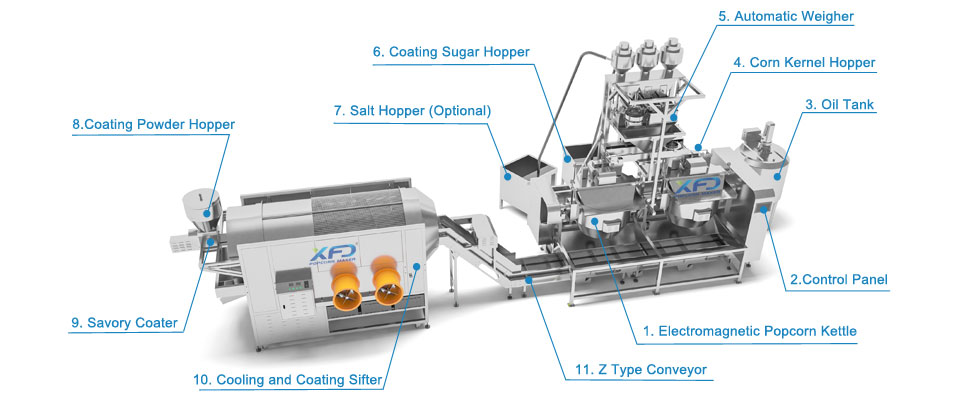
An integrated industrial popcorn line coordinates popping, conveying, cooling, and coating operations.
Businesses planning to increase output can review the multiple-machine electromagnetic popcorn production line. This type of configuration is relevant when a factory needs greater throughput than a single popping machine can provide.
Cooling, Coating, and Packaging Can Limit Total Output
For a complete popcorn factory, popping speed is only one part of the production process. The finished product must also move through cooling, seasoning or coating, inspection, and packaging at a compatible rate.
If the popping equipment produces popcorn faster than the cooling or coating equipment can handle, product may accumulate between stages. Operators may then need to slow down the popping process, reducing the effective output of the entire line.
Flavor requirements also matter. Plain popcorn and caramel-coated popcorn may require different processing arrangements. A factory producing multiple flavors may need additional time for recipe changes, cleaning, and quality checks.
For manufacturers producing flavored popcorn at scale, XFD's hot-air popcorn and caramelizer production line combines popping and coating equipment in an integrated system. The product page describes a configuration intended for approximately 180–250 kg/h of caramel or chocolate popcorn output. This is a specific product configuration, not a capacity that applies to all XFD lines.
When comparing production systems, ask for the expected output of the complete line with the intended recipe. A high-capacity popper alone does not guarantee that the finished, coated, and packaged product will reach the same hourly rate.
Automation, Operator Workflow, and Downtime
Automation can improve effective production capacity by reducing manual handling and helping different processing stages operate in a coordinated way. Features such as automatic feeding, oil supply, kettle discharge, conveying, and temperature control can make production more consistent.
Nevertheless, the actual benefit depends on how the equipment is configured and operated. A factory may still lose production time through ingredient replenishment, cleaning, maintenance, flavor changes, packaging material replacement, or equipment stoppages.
For a more realistic capacity estimate, distinguish between rated hourly output and effective output during a normal production shift.
Effective hourly output = total finished product ÷ actual production time
For example, if a line produces 400 kg of finished popcorn during eight scheduled hours, its effective output over that shift is 50 kg/h. This calculation includes the effect of any downtime that occurred within those eight hours.
Recording actual output over several shifts can help manufacturers identify whether the main limitation is the popping cycle, operator workflow, product changeovers, or downstream equipment.
How Much Popcorn Can an Industrial Machine Produce Per Hour?
Industrial popcorn machine capacity varies by design and configuration. XFD publishes several production-line options with different rated outputs, allowing businesses to compare equipment against their own factory requirements.
| Equipment configuration | Published capacity | Typical consideration |
|---|---|---|
| Semi-automatic popcorn production and cooling line | 50–60 kg/h | Medium-scale production and potential expansion |
| Fully automatic electromagnetic popcorn production line | 120–160 kg/h | Automated factory production and coating |
| Industrial hot-air popping and caramelizing line | 180–250 kg/h for the specified caramel or chocolate popcorn configuration | Higher-volume flavored popcorn production |
These figures refer to specific equipment configurations published by XFD. They should not be interpreted as directly comparable guarantees because the production process, product type, and rated output conditions may differ.
To estimate daily production, multiply the expected hourly output by actual productive hours. For example, a line producing 120 kg/h over six productive hours would make approximately 720 kg. This is a planning estimate, not a guarantee of daily output.
Before purchasing equipment, confirm whether the quoted capacity refers to raw kernel input, popped popcorn, or finished flavored popcorn. Also clarify which auxiliary equipment is included and whether the stated output assumes continuous operation.
How to Choose the Right Commercial Popcorn Machine Capacity
The best commercial popcorn machine is not necessarily the one with the highest rated output. It is the one that can meet the business's actual demand while maintaining product quality and manageable operating costs.
Before selecting equipment, buyers should evaluate the following points:
- Required output: Estimate the kilograms or batches needed per hour, including peak demand.
- Application: Identify whether the equipment will serve a cinema, concession stand, snack shop, or popcorn factory.
- Product type: Consider plain, caramel, chocolate, and other flavored popcorn varieties.
- Automation level: Decide which stages need manual, semi-automatic, or automatic operation.
- Complete line capacity: Make sure conveying, cooling, coating, and packaging can keep up with the popping equipment.
- Operating requirements: Check available electrical supply, installation space, cleaning access, and maintenance needs.
- Future expansion: Consider whether the equipment can accommodate higher output if demand grows.
For a cinema or retail business, kettle capacity and peak-hour service requirements may be the most important considerations. For a manufacturer, the better starting point is the required finished-product output per hour and the capacity of the complete processing line.
XFD offers commercial and industrial popcorn equipment for different production needs. By matching the required output with the appropriate machine configuration, businesses can plan a production system that supports current demand and future growth.
Frequently Asked Questions About Commercial Popcorn Machine Capacity
What factors affect commercial popcorn machine capacity?
The main factors are kettle size, popping cycle time, heating technology, kernel quality, number of kettles, automation, and operator workflow. For industrial production, cooling, coating, and packaging capacity also influence total finished output.
Does a larger popcorn kettle always produce more popcorn per hour?
No. A larger kettle can process more kernels per batch, but hourly output also depends on heating speed, popping time, unloading, reloading, and the machine's ability to handle the batch consistently.
How do you calculate popcorn machine output per hour?
For batch equipment, multiply the finished popcorn produced per batch by the number of completed batches per hour. For industrial lines, divide the finished product output by the actual production time to calculate effective hourly output.
What is the capacity of an XFD industrial popcorn production line?
XFD publishes different configurations, including a semi-automatic line rated at approximately 50–60 kg/h and a fully automatic electromagnetic line rated at approximately 120–160 kg/h. Other specialized configurations may offer different output ranges.
Can electromagnetic heating increase popcorn machine capacity?
It can help shorten the popping cycle in suitable machine configurations. The actual capacity improvement depends on the heating system, kettle design, batch size, operating conditions, and the performance of the complete production line.
Why is actual factory output lower than the machine's rated capacity?
Actual output may be reduced by cleaning, maintenance, ingredient loading, product changeovers, operator delays, quality checks, and bottlenecks in cooling, coating, or packaging. Rated capacity and effective shift output should therefore be evaluated separately.
How do I choose a popcorn machine for a large-scale factory?
Start with the required finished-product output per hour, the popcorn varieties to be produced, the level of automation, and the available production space. Then confirm that the popping, cooling, coating, and packaging stages can support the target output.
Can a popcorn production line be expanded when demand increases?
Some XFD industrial configurations support adding popcorn machines to increase production capacity. Expansion feasibility depends on the existing line design, utilities, material handling, and downstream equipment capacity.
In summary, commercial popcorn machine capacity depends on the entire production process, not just one machine specification. Buyers who evaluate batch cycle time, heating technology, raw material quality, automation, and downstream processing can make a more accurate equipment decision and build a production line suited to their actual business needs.