Setting up a popcorn factory requires more than an industrial popcorn machine. A complete production setup may include raw material feeding, popcorn popping equipment, oil supply systems, cooling and filtering equipment, flavor coating machines, conveying systems, and packaging equipment. The exact configuration depends on the factory's target output, popcorn recipes, automation requirements, and packaging format.
For manufacturers planning a new snack food facility or expanding an existing production operation, the key is to match each machine to the next production step. XFD Popcorn provides industrial popcorn equipment and integrated production line solutions that can be configured for different manufacturing requirements.
This guide explains what equipment a popcorn factory needs, how each machine works, and what to consider when selecting a suitable popcorn production line.
What Equipment Does a Popcorn Factory Need?
A popcorn factory typically needs five main groups of equipment: popping machines, ingredient feeding and oil supply systems, cooling and seasoning equipment, conveying systems, and packaging machines. Larger facilities may also require automated controls, product storage, and additional handling equipment.
The following table summarizes the main equipment and its role in popcorn manufacturing.
| Equipment | Main Function | When It Is Needed |
|---|---|---|
| Industrial popcorn machine | Pops corn kernels into finished popcorn. | Every popcorn manufacturing operation. |
| Kernel feeding and oil supply system | Delivers ingredients to the popping equipment. | Batch or automated production systems, depending on configuration. |
| Cooling and filtering machine | Cools popcorn and helps remove unpopped kernels and small particles. | Production lines requiring controlled cooling and product separation. |
| Seasoning or coating machine | Applies flavor powders, sugar coatings, caramel, or other recipe-specific ingredients. | Flavored popcorn manufacturing. |
| Conveyor and elevator | Transfers popcorn between processing stages. | Integrated production lines and higher-volume operations. |
| Packaging machine | Measures and packs finished popcorn for storage, distribution, or retail. | Factories selling packaged products. |
Not every factory needs every machine from the beginning. A small operation producing a limited range of popcorn may start with a simplified production line, while a manufacturer supplying supermarkets or distributors may need automated coating, conveying, and packaging systems.
Industrial Popcorn Machine: The Core of the Factory
The industrial popcorn machine is the central piece of equipment in a popcorn factory. It converts raw corn kernels into popped popcorn, and its output affects the capacity of every downstream process.
Industrial popcorn machines use different heating methods and production configurations. Electromagnetic induction systems are one option for manufacturers looking for efficient heating and repeatable production. Hot-air popping systems may be appropriate for factories producing particular popcorn styles or working with specific process requirements.
When choosing an industrial popcorn machine, evaluate:
- Required output in kilograms per hour.
- Batch size and popping cycle.
- Desired popcorn shape, such as butterfly or mushroom popcorn.
- Heating method and energy requirements.
- Compatibility with sugar, oil, and other ingredients used in the recipe.
- Available factory space and planned production expansion.
For example, XFD lists a multi-machine electromagnetic production line with a stated output of up to 160 kg of popcorn per hour in its specified configuration. Actual production results depend on the machine setup, recipe, operating conditions, and product requirements.
Explore XFD's industrial popcorn machines and production lines to compare available configurations for factory-scale manufacturing.
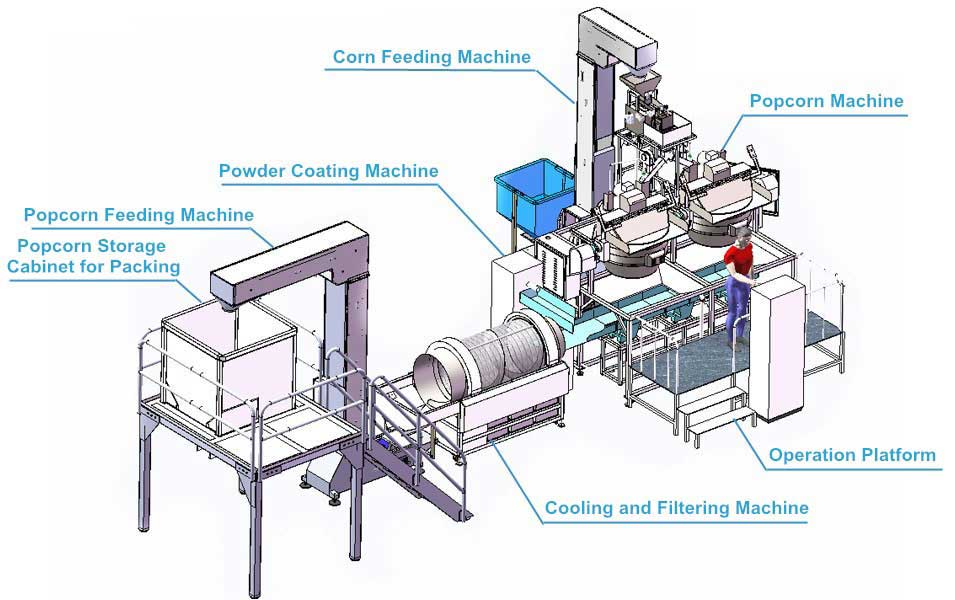
Example of an integrated popcorn production line layout.
Ingredient Feeding and Oil Supply Equipment
Consistent ingredient delivery is important for stable popcorn production. Depending on the production line, a factory may need kernel hoppers, feeding systems, oil storage tanks, oil pumps, and metering equipment.
These systems help supply ingredients to the popping machines in a controlled manner. In automated installations, feeding and oil delivery can be coordinated with the popping process to reduce repetitive manual work and support more consistent production.
The required configuration depends on whether the factory produces conventional salted popcorn, oil-popped popcorn, caramel popcorn, or several different products. Sugar and other ingredients may need to enter the process at different stages, depending on the recipe and machine design.
When requesting a quotation, provide the equipment supplier with your recipe requirements, planned hourly output, ingredient handling preferences, and expected production schedule. This information helps determine whether a basic feeding arrangement or a more automated supply system is appropriate.
Cooling and Filtering Equipment
After popping, popcorn may need to be cooled and separated before flavoring or packaging. Cooling helps remove excess heat, while filtering or sifting equipment can separate unpopped kernels and small particles from the finished product.
Cooling is particularly important when the next step involves coating popcorn with sugar, caramel, or flavor powders. Product temperature, residual oil, coating formulation, and the time between processing stages can all affect coating performance and the final texture.
For larger factories, cooling and filtering equipment should be selected according to the upstream popping capacity. If the cooling section cannot handle the volume delivered by the popcorn machines, it can become a bottleneck even when the popping equipment itself has sufficient capacity.
Consider the product's target texture, expected processing temperature, cleaning requirements, and available floor space when planning this stage.
Popcorn Seasoning and Coating Machines
Factories producing flavored popcorn often need dedicated coating or seasoning equipment. The appropriate machine depends on whether the product uses dry seasoning powders, sugar-based coatings, caramel, chocolate-style coatings, or other formulations.
A dry seasoning machine distributes flavor powders over the popcorn. A caramelizer or cooker-and-coater system is designed for recipes that require cooking and distributing a coating. Some production lines combine several processing functions, while others use separate machines for greater flexibility.
Before selecting a popcorn coating machine, consider:
- The number of flavors produced in one shift.
- Whether the coating is dry, liquid, or sugar-based.
- The required coating uniformity and finished texture.
- Cleaning and changeover time between flavors.
- Whether coating capacity matches the output of the popping section.
For example, a factory producing caramel popcorn may require a large cooker and coater, while a manufacturer adding cheese or other dry flavor powders may need a suitable seasoning drum. The right solution depends on the actual formulation rather than simply the machine's maximum capacity.
XFD offers popcorn production and coating line equipment for manufacturers looking to produce multiple popcorn flavors within an integrated process.
Conveyors and Product Transfer Systems
Conveyors and elevators move popcorn between popping, cooling, seasoning, and packaging stages. They help reduce repeated manual handling and connect individual machines into a continuous or semi-automated production workflow.
The conveyor layout should reflect the factory's floor plan, production capacity, and product flow. Excessive transfer points can increase handling complexity, while poorly matched conveyor capacity may interrupt the entire line.
For a popcorn factory, check the following before installation:
- Whether the conveyor can handle the required hourly volume.
- Whether the transfer system is suitable for fragile, lightweight popcorn.
- Whether equipment can be accessed for cleaning and maintenance.
- Whether the layout allows future expansion or additional processing stages.
Integrated layouts can help coordinate the output of the popping equipment with cooling and coating operations, reducing unnecessary handling between stages.
Automatic Popcorn Packaging Equipment
Packaging is the final major stage for factories selling ready-to-eat popcorn. Depending on the product format, the packaging section may include a weighing or metering system, bag-forming and sealing equipment, a filling machine, or other packing equipment.
The right packaging solution depends on the type and size of the package, required packing speed, portion accuracy, product fragility, and whether the factory sells single-serve bags, family-size packs, or bulk popcorn.
Packaging capacity should be evaluated together with the output of the upstream equipment. A production line that pops and coats popcorn faster than the packaging machine can pack it may require a buffer or a higher-capacity packing system.
For factories planning an integrated setup, XFD's fully automatic popcorn production and packing line is listed for factory applications with a stated output range of 100–160 kg/h in the specified configuration. Confirm the required package format and actual finished-product capacity with the supplier before selecting a line.
How Does a Complete Popcorn Production Line Work?
A typical flavored popcorn manufacturing process follows a sequence of connected stages. The exact workflow varies according to the popping technology, recipe, coating method, and packaging system.
- Raw material preparation: Prepare popcorn kernels, oil, sugar, and other recipe ingredients.
- Ingredient feeding: Deliver kernels and other required ingredients to the appropriate processing equipment.
- Popping: Use an industrial popcorn machine to pop the kernels.
- Cooling and filtering: Cool the popcorn and separate unpopped kernels or unwanted particles where required.
- Flavoring and coating: Apply the selected seasoning, sugar, or caramel coating.
- Final cooling and handling: Allow the coated product to reach suitable conditions for the next process.
- Packaging: Measure, fill, and seal the finished popcorn in the selected packaging format.
- Inspection and storage: Check the finished product and store it under appropriate conditions before distribution.
Each stage should be designed around the same production target. A complete line is not simply a collection of high-capacity machines; it is a coordinated system in which ingredient delivery, popping, cooling, coating, and packing can operate at compatible rates.
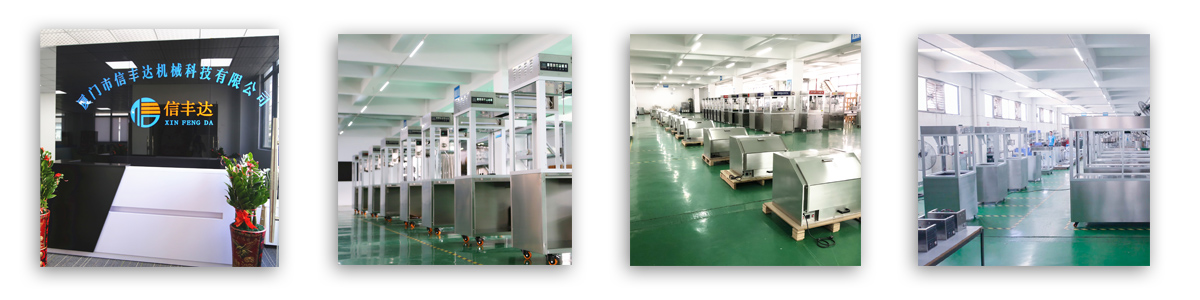
XFD factory facilities for popcorn equipment manufacturing.
How Much Equipment Does a Popcorn Factory Need?
The number of machines required depends on production capacity, the types of popcorn being manufactured, the degree of automation, and the packaging requirements. A small factory and a large industrial plant should not automatically use the same equipment configuration.
| Factory Requirement | Possible Equipment Configuration |
|---|---|
| Small-scale production | A suitable popcorn machine, basic ingredient handling, and separate coating or packaging equipment as needed. |
| Growing snack manufacturer | Industrial popping equipment, cooling and filtering, seasoning or coating equipment, conveyors, and a compatible packaging solution. |
| Large-scale popcorn factory | A customized automated production line with coordinated feeding, popping, cooling, coating, conveying, and packaging systems. |
These are planning examples, not fixed equipment packages. Some machines combine multiple functions, and not every factory requires a separate machine for every stage.
For a factory targeting 100–160 kg/h, for example, the equipment supplier should assess the complete production process rather than selecting a popcorn machine based on output alone. Cooling, flavor coating, transfer, and packaging must all be able to support the required throughput.
How to Choose the Right Popcorn Factory Equipment
Before purchasing popcorn manufacturing equipment, prepare a clear production plan. This helps the supplier recommend a practical configuration instead of offering machines that may not work efficiently together.
- Define the production target: Specify the required output per hour and expected operating hours per day.
- Identify the product range: Explain whether you will produce classic salted popcorn, caramel popcorn, cheese popcorn, or multiple flavors.
- Confirm the automation level: Decide which stages will be manual, semi-automatic, or fully automatic.
- Match downstream capacity: Ensure cooling, coating, conveying, and packaging can handle the planned production rate.
- Check the factory layout: Review floor space, power supply, utilities, material flow, and maintenance access.
- Plan for cleaning and maintenance: Ask about food-contact materials, cleaning procedures, spare parts, and after-sales support.
- Allow for future expansion: If production is expected to grow, discuss modular equipment or additional popping machines before finalizing the layout.
It is also useful to ask the supplier to clarify whether the quoted capacity refers to popped popcorn, coated finished popcorn, or packaged product. These figures may differ because of recipe ingredients, process losses, changeovers, and downstream limitations.
Why Consider XFD for Popcorn Factory Equipment?
XFD focuses on popcorn machinery and production solutions for commercial and industrial applications. Its product range includes industrial popcorn machines, popcorn production and coating lines, caramelizing equipment, and automatic production and packing systems.
For buyers planning a new popcorn factory, working with a supplier that understands the complete production process can make it easier to coordinate equipment selection, layout, output requirements, and future expansion.
Rather than choosing machines separately based only on individual specifications, discuss your product recipes, target output, packaging format, and factory conditions with the equipment supplier. These details provide a more useful basis for designing a production line.
To review available configurations, visit the XFD industrial popcorn equipment range or contact the team through the official website to discuss your factory requirements.
Frequently Asked Questions About Popcorn Factory Equipment
What is the most important machine in a popcorn factory?
The industrial popcorn machine is the core production unit because it turns raw kernels into popcorn. However, cooling, coating, conveying, and packaging equipment must also support the required output for the factory to operate efficiently.
What equipment is needed to make flavored popcorn commercially?
A flavored popcorn factory typically needs a popcorn machine, ingredient feeding equipment, suitable cooling and filtering equipment, and a seasoning or coating machine. A packaging machine is also needed when the finished product is sold in packaged form. The exact configuration depends on the recipe.
Can one production line make different popcorn flavors?
Yes. Some industrial popcorn production and coating lines can support multiple flavors, depending on the machine configuration and recipe. The factory should confirm coating compatibility, ingredient feeding requirements, and cleaning procedures for changing between products.
How much popcorn can an industrial production line make per hour?
Production capacity varies by machine type and configuration. XFD lists industrial popcorn solutions with different output levels, including a multi-machine electromagnetic line rated at up to 160 kg/h in its specified configuration. Actual output should be confirmed for the intended recipe and finished product.
Does a popcorn factory need an automatic packaging machine?
Not every small operation needs fully automatic packaging from the start. However, factories supplying packaged popcorn at higher volumes may benefit from a compatible automatic packaging system to improve throughput and reduce repetitive manual handling.
How do I choose the right popcorn production line for my factory?
Start with your required output in kg/h, product flavors, popping method, packaging format, available floor space, and automation goals. Ask the equipment supplier to evaluate the capacity of the complete line, including cooling, coating, conveying, and packaging, before confirming the configuration.