Key Engineering Takeaway
Effective thermal management in sheet metal enclosures combines high-conductivity base metals (such as 5052 aluminum at 138 W/m·K), strategic airflow engineering (chimney-effect louvers or filtered forced-air fans), and closed-loop heat exchangers or dual-wall solar shields when strict IP65/IP66 environmental sealing is required.
Heat is the primary enemy of modern industrial electronics. As power densities increase in telecom base stations, battery energy storage systems (BESS), and factory automation cabinets, internal components like IGBTs, transformers, and power supplies generate substantial waste heat. Every 10°C rise above a component's rated operating temperature can cut its expected service life in half.
Designing a metal housing that dissipates this heat reliably—without compromising structural strength, electromagnetic shielding, or ingress protection—requires integrating thermal physics directly into the sheet metal fabrication process. Below is a practical engineering framework for designing thermally efficient metal enclosures.
How Base Material Conductivity Governs Passive Heat Dissipation
Before adding fans or air conditioners, the enclosure walls themselves act as a passive heat sink. Heat transfers from internal components to the ambient air through conduction, convection, and radiation. The raw metal alloy you specify directly controls how fast heat moves through the cabinet walls:
5052 Aluminum (~138 W/m·K): Conducts heat nearly three times faster than carbon steel. Ideal for sealed, passively cooled outdoor housings and lightweight telecom boxes where natural wall dissipation is critical.
Cold-Rolled Carbon Steel (~50 W/m·K): Offers moderate thermal conductivity with superior structural rigidity and lower raw material cost. Typically paired with louvers or active fan cooling for higher heat loads.
304 / 316 Stainless Steel (~15 W/m·K): Provides unmatched corrosion resistance but acts as a poor thermal conductor. Stainless cabinets housing high-wattage electronics almost always require active cooling or dedicated heat exchangers.
Passive Cooling: Louvers, Perforations, and Dual-Wall Solar Shields
For low-to-moderate heat loads in indoor or sheltered environments, passive natural convection is the most reliable cooling method because it has zero moving parts and requires no electrical power. By placing intake vents near the bottom of the cabinet and exhaust vents near the top, engineers leverage the natural "chimney effect"—as internal air heats up, it rises and exits the top, drawing cooler ambient air in from the bottom.
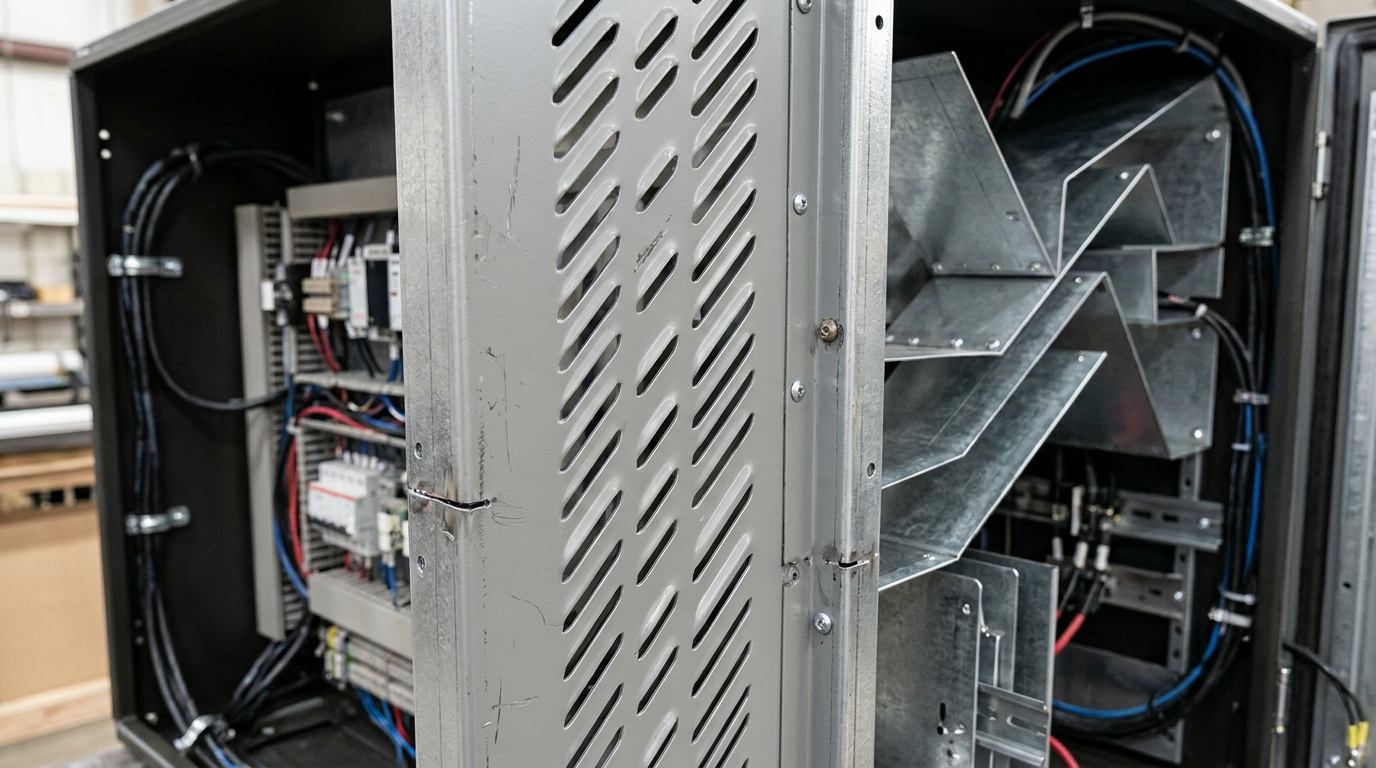
When designing Ventilated Industrial Metal Enclosures, stamped louvers are generally preferred over simple flat perforations for environments exposed to dripping water or falling debris. Downward-angled louvers shed water while maintaining airflow. For outdoor cabinets exposed to direct sunlight, adding a secondary outer sheet metal skin—known as a dual-wall solar shield—creates a 15mm to 25mm air gap around the inner sealed box. The outer skin absorbs the sun's radiant energy and vents it upward through the gap, cutting internal solar heat gain by up to 40%.
DFM Rule for Stamped Louvers: Keep louver openings at least 3 times the material thickness away from any bend line or cabinet edge. Placing louvers too close to a bend causes flange distortion during press brake forming.
Active Cooling: Forced Air, Baffles, and Closed-Loop Systems
When passive convection cannot keep internal temperatures below the safe threshold (typically 40°C to 50°C for industrial electronics), active cooling is required. The most economical active method is forced-air cooling using filtered axial fans or centrifugal blowers.
To maximize fan efficiency, always design for positive internal pressure by mounting the fan at the lower intake rather than the upper exhaust. Positive pressure forces clean, filtered air into the enclosure and pushes air out through any microscopic door seams, preventing unfiltered dust from being sucked inside. Inside crowded cabinets, airflow often takes the path of least resistance and bypasses hot components. Integrating Precision CNC Bent Heat Baffles and internal air ducts directs high-velocity air directly across power modules and heat sinks.
If the enclosure must maintain a strict IP65, IP66, or NEMA 4X seal—or if the outside ambient temperature is hotter than the desired internal temperature—open-loop fans cannot be used. Instead, fabricators engineer mounting cutouts and structural reinforcement brackets for closed-loop air-to-air heat exchangers, thermoelectric coolers (TECs), or compressor-based enclosure air conditioners.
Comparing Enclosure Cooling Methods by Heat Load and IP Rating
Selecting the right thermal architecture depends on balancing three variables: internal heat load (watts), ambient temperature, and required ingress protection:
| Cooling Architecture | Heat Load Capacity | Max IP Rating | Best Application |
|---|---|---|---|
| Sealed Natural Convection | Low (< 100W) | IP66 / IP67 | Outdoor sensors, junction boxes, low-power telemetry |
| Stamped Louvers & Vents | Low to Moderate | IP23 to IP43 | Indoor control cabinets, server racks, power supplies |
| Filtered Forced-Air Fans | Moderate to High | IP54 / IP55 | Factory PLCs, VFD drives, indoor EV chargers |
| Air-to-Air Heat Exchanger | High | IP65 / IP66 | Dusty industrial plants, outdoor telecom cabinets |
| Closed-Loop AC / Liquid | Very High (kW+) | IP65 / IP66 | Battery energy storage (BESS), desert solar inverters |
Surface Finishing and Color: Controlling Radiant Heat
Surface coatings are rarely discussed in thermal engineering, yet they significantly impact radiant heat transfer. For outdoor enclosures exposed to direct sunlight, exterior color is critical. A dark gray or black cabinet absorbs over 85% of incident solar radiation, rapidly raising internal temperatures even before the electronics are turned on. Specifying a light-colored, UV-resistant polyester powder coat—such as RAL 7035 Light Gray or pure white—reflects solar energy and keeps the cabinet substantially cooler.
Conversely, unpainted, mirror-polished bare metal has very low thermal emissivity, meaning it is poor at radiating internal heat outward. On Corrosion-Resistant Stainless Steel Cabinets deployed in coastal or chemical zones, applying a thin, light-colored exterior powder coat or brushed finish improves radiative heat dissipation while adding an extra barrier against chloride pitting.
Integrating Thermal Features Into Sheet Metal Production
Thermal management should never be an afterthought bolted onto a finished cabinet. Cutting oversized fan apertures or heavy AC mounting brackets after fabrication weakens structural rigidity and risks destroying corrosion-resistant coatings. When engineered early in the CAD phase, louvers, baffle mounts, and reinforced cooling cutouts can be laser-cut, punched, and formed in a single streamlined workflow.
At Huapusheng, our DFM engineers work directly with OEM hardware teams to optimize enclosure layouts for both manufacturability and thermal reliability. Whether you need high-density louver stamping, dual-wall outdoor assemblies, or precision-welded housings ready for closed-loop cooling units, send us your 3D STEP files to review your next project.
Frequently Asked Questions
Can I use cooling fans in an IP65 outdoor enclosure?
Standard filtered fans typically max out at IP54 or IP55. To maintain a true IP65 or IP66 rating against pressurized water jets, you must either add specialized hooded rain shrouds tested to IP65 or switch to a closed-loop air-to-air heat exchanger or enclosure air conditioner that keeps outside air completely separated from internal electronics.
Does powder coating insulate a metal enclosure and trap heat?
A standard 60 to 80 micron powder coat layer has a negligible effect on conduction through the metal wall. In fact, because polymer coatings have higher thermal emissivity than bare shiny metal, a thin powder coat often improves radiative heat transfer—provided you choose a light exterior color for outdoor cabinets exposed to sunlight.
How much airflow space is needed around internal heat-generating components?
As a general thermal layout rule, leave at least 50mm to 100mm of unobstructed clearance above and below high-wattage components (like VFDs or power supplies) so convection currents can flow freely. Mounting the hottest components near the upper exhaust prevents their waste heat from pre-heating sensitive logic boards below.