For popcorn manufacturers, good coating adhesion means more than making every kernel look evenly flavored. The coating must stay on the popcorn during mixing, cooling, handling, and packaging, while the finished product should remain easy to separate and pleasant to eat. If the coating is too sticky or applied unevenly, popcorn can form hard clusters, create excessive production waste, and lose its consistent appearance.
So, how can popcorn manufacturers improve coating adhesion without creating excessive clumping? The key is to balance coating formulation, application temperature, mixing action, coating quantity, and cooling conditions. The right popcorn coating machine can also help manufacturers distribute flavoring more consistently and maintain a repeatable production process.
For commercial snack producers, these adjustments can improve product consistency without simply adding more syrup, oil, or seasoning. The best approach depends on whether the product is caramel popcorn, cheese popcorn, chocolate popcorn, or another flavored variety.
Why Does Popcorn Coating Fail to Adhere Properly?
Poor coating adhesion usually results from a mismatch between the coating material and the processing conditions. Some kernels remain nearly bare, while others collect too much coating and stick together. These problems can occur in the same batch because coating distribution is not always uniform.
Several common factors contribute to this problem:
- Incorrect coating viscosity: A coating that is too thick may not spread evenly, while one that is too thin may run off the kernel before it sets.
- Excessive coating application: Too much liquid caramel, syrup, or oil-based flavoring can create bridges between adjacent kernels.
- Uneven mixing: Insufficient movement leaves some kernels undercoated, while overly aggressive mixing can break fragile popcorn.
- Unsuitable product temperature: If the popcorn or coating is outside the appropriate processing temperature range, spreading and setting may become inconsistent.
- Excess moisture: Moisture from ingredients or the surrounding environment can affect coating behavior and finished-product crispness.
- Inconsistent kernel size: Large and small pieces may move differently through the coating process, making uniform coverage more difficult.
Manufacturers should identify which factor is causing the problem before changing the entire recipe. For example, if the coating is already sufficiently sticky but several kernels are joined by thick caramel bridges, increasing the syrup content is unlikely to solve the issue. It may make clumping worse.
How Can Manufacturers Improve Coating Adhesion?
The most effective way to improve popcorn coating adhesion is to create a thin, consistent layer that covers the kernel surface without leaving excessive material between neighboring pieces. This requires coordinated control of the formulation, application method, and mixing process.
Start with the coating formulation. Check the balance of sugar, syrup, fat, water, and dry flavoring ingredients according to the specific recipe. Caramel coatings need suitable cooking and setting characteristics, while dry cheese or savory seasonings may depend more on an appropriate oil carrier and effective mixing. There is no single formula that works equally well for every popcorn flavor.
Apply the coating gradually. Instead of introducing a large quantity of liquid coating at once, test a controlled application rate that allows the material to spread across the moving popcorn. The ideal rate depends on batch size, coating viscosity, kernel condition, and equipment design. Gradual application can reduce localized wet spots and the formation of sticky clusters.
Maintain consistent mixing. Popcorn needs enough movement to expose different surfaces to the coating, but the mixing action should not be so aggressive that it breaks the kernels. A well-matched caramelizing and mixing system can help manufacturers distribute coating materials more evenly while processing different flavors.
When adjusting a recipe, change one variable at a time and record the results. This makes it easier to determine whether improved adhesion comes from a better coating ratio, more consistent mixing, or a change in temperature.
How Should Temperature and Mixing Time Be Controlled?
Temperature control is particularly important for caramel popcorn and other products that use cooked sugar coatings. The coating must be fluid enough to spread during application and then develop the desired texture as the product cools. If the temperature is too low during application, the coating may become difficult to distribute. If the product remains too warm or the coating does not set properly, adjacent kernels may stick together.
Manufacturers should establish a suitable temperature range through recipe testing rather than relying on a universal setting. Sugar concentration, heating method, batch size, and the type of fat or syrup can all affect the result. Temperature readings should also be checked against actual product behavior, not just the equipment display.
Mixing time requires the same attention. Too little mixing can produce uneven coverage, but extending the cycle indefinitely does not guarantee better adhesion. Once the coating has been distributed adequately, additional mixing may increase kernel breakage or encourage sticky pieces to contact one another repeatedly.
For industrial production, equipment with adjustable heating and mixing controls makes it easier to test and maintain process settings. XFD's industrial caramelizer and cooker-coater combines heating and mixing functions, with an adjustable electromagnetic heating system, an agitator blade, a helical impeller, and mixing baffles. These features support controlled coating operations, although the final settings must still be matched to the product recipe.

Mixing components help distribute coating ingredients throughout the batch.
How Can Manufacturers Reduce Clumping During Coating?
Improving adhesion and reducing clumping are related goals, but they are not exactly the same. Adhesion determines whether the coating stays on the popcorn. Clumping occurs when coating material connects neighboring kernels or when sticky surfaces remain in contact before the coating has set.
To control clumping without sacrificing flavor coverage, manufacturers should focus on the following process adjustments.
- Control the coating-to-popcorn ratio. Measure ingredient quantities consistently and avoid adding extra coating simply to improve visual coverage. Excess material can increase sticking without providing a meaningful improvement in adhesion.
- Improve coating distribution. Ensure that the mixing action exposes the popcorn to the coating evenly, rather than concentrating liquid or seasoning in one part of the batch.
- Prevent excessive accumulation. Check whether syrup or oil is entering the coating chamber too quickly or collecting in specific areas.
- Manage cooling conditions. Allow coated popcorn to cool under suitable conditions before packing. The appropriate cooling time depends on the coating, product temperature, and ambient environment.
- Check ingredient consistency. Differences in syrup concentration, oil temperature, or powder particle size can affect the repeatability of each batch.
- Handle the product gently. Excessive agitation can break kernels, while insufficient movement may leave clusters undetected until the product reaches packaging.
It is also important to distinguish between acceptable clusters and actual process defects. Some gourmet caramel popcorn products are intentionally produced in clusters. For individually separated kernels, however, manufacturers need to establish a clear clump-size or separation standard and use the same inspection method for every trial batch.
For dry seasoning applications, a rotating tumbler can help distribute flavor powders without using a heated cooking process. The appropriate equipment depends on whether the recipe uses dry powder, oil-assisted seasoning, cooked caramel, or another coating material.
Why Is Cooling Important for Coating Adhesion?
Cooling is not simply the final step before packaging. It affects whether the coating sets properly, whether neighboring kernels separate easily, and whether the finished popcorn maintains its intended texture during storage.
If caramel-coated popcorn is packed while the coating is still too warm or tacky, kernels may stick together inside the package. Depending on the formulation and environment, trapped moisture or condensation can also contribute to texture deterioration. Conversely, cooling too aggressively or under unsuitable conditions may affect the coating's final texture.
Manufacturers should establish a repeatable cooling process based on product temperature, coating type, ambient humidity, and packaging requirements. Before increasing packaging speed, confirm that the coated popcorn has reached the appropriate condition for the next stage.
At factory scale, the cooling stage should be coordinated with coating and conveying capacity. XFD's fully automatic electromagnetic popcorn production and coating line is designed for large-scale flavored popcorn production, with an output range of 120–160 kg/h listed by XFD. Actual output and the suitable process configuration depend on the product, recipe, and selected equipment arrangement.
How Can Manufacturers Test Coating Quality Consistently?
A practical quality-control process should measure more than appearance immediately after coating. Manufacturers need to know whether the coating remains attached after cooling, handling, and packaging.
A repeatable trial can include the following checks:
- Coating coverage: Inspect samples from different parts of the batch to identify bare areas, heavy deposits, and uneven color.
- Clumping rate: Count or weigh clusters using a consistent definition and compare results between trial batches.
- Loose coating: Check for excessive powder or coating residue that separates from the kernels during handling.
- Kernel breakage: Record broken pieces and fragments to determine whether the mixing process is too aggressive.
- Texture after cooling: Assess whether the popcorn remains crisp and whether the coating is excessively sticky or hard.
- Packaging performance: Inspect samples after a defined holding period to identify sticking, coating transfer, or other quality changes.
For useful comparisons, keep the popcorn variety, batch size, coating recipe, and inspection method consistent. Adjust one process variable at a time, then compare the results against a baseline batch. This helps identify improvements that can be repeated in normal production.
Manufacturers scaling up production should also confirm that coating performance remains stable at the target throughput. A recipe that works well in a small test batch may behave differently in a larger machine because heat transfer, mixing patterns, and product residence time can change.
How Should Manufacturers Choose Popcorn Coating Equipment?
The right equipment depends on the type of coating, desired output, degree of automation, and available production space. Manufacturers should identify their main quality problem before choosing a machine. Uneven dry seasoning, sticky caramel clusters, and inconsistent industrial batch output may require different solutions.
For small and medium-sized operations, a suitable coating tumbler or combined popping and caramelizing machine may provide the flexibility needed for multiple flavors. Manufacturers producing cooked caramel coatings should pay particular attention to heating control, mixing structure, cleaning access, and batch consistency.
For higher-volume production, an integrated line can help coordinate popping, ingredient feeding, coating, cooling, and downstream handling. XFD offers large-scale popcorn production and coating equipment for manufacturers evaluating industrial production workflows. The configuration includes popping, oil feeding, conveying, cooling, and coating-related equipment.
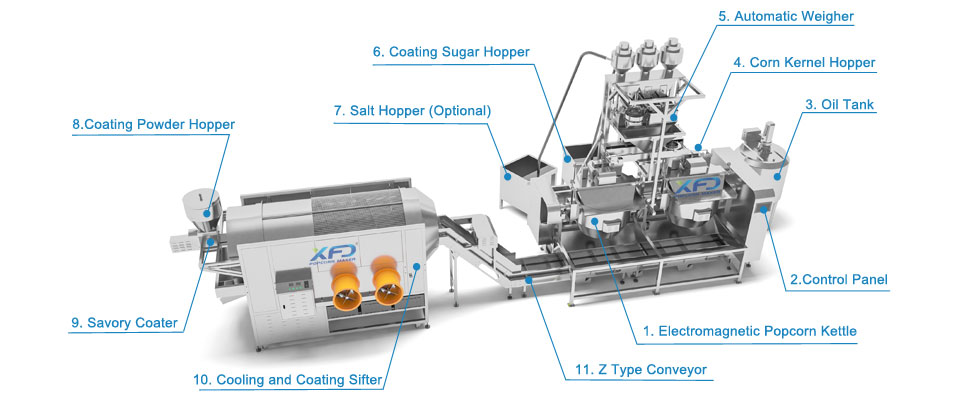
An integrated popcorn line connects popping, ingredient feeding, coating, and cooling operations.
Before purchasing equipment, provide the supplier with the target output in kg/h, the popcorn varieties, the coating ingredients, the required level of automation, and the acceptable clumping rate. It is also useful to share the current production problem and, where possible, sample products or process videos. This information helps the supplier evaluate whether the proposed equipment is appropriate for the actual application.
How XFD Helps Popcorn Manufacturers Improve Coating Consistency
XFD focuses on popcorn equipment, including coating machines, caramelizers, and industrial popcorn production lines. For manufacturers dealing with uneven flavor coverage or excessive clumping, the first step is to identify whether the problem comes from the recipe, the processing conditions, or a mismatch between the coating equipment and the required output.
The company's equipment range includes different solutions for dry seasoning, cooked coatings, and larger-scale production. Adjustable heating, suitable mixing components, and coordinated production stages can help manufacturers establish a more repeatable process when the equipment is correctly matched to the product.
There is no single machine setting that eliminates clumping for every recipe. The most reliable results come from combining appropriate ingredients, controlled coating application, consistent mixing, and suitable cooling conditions.
If you are evaluating equipment for a new popcorn factory or improving an existing production line, visit XFD Popcorn to explore available solutions. Sharing your target output, coating type, and current quality challenges will help the team understand your production requirements.
Frequently Asked Questions
How can popcorn manufacturers improve coating adhesion without creating excessive clumping?
Manufacturers should optimize the coating formulation, apply the coating evenly, maintain suitable mixing and temperature conditions, and allow the product to cool properly. Adding more syrup or oil is not always the solution because excessive coating can connect neighboring kernels and increase clumping.
Why does caramel popcorn become sticky and form large clusters?
Common causes include excessive coating, unsuitable syrup concentration, uneven mixing, insufficient setting, and unsuitable cooling conditions. Manufacturers should check the recipe and process settings before making major equipment or ingredient changes.
Does a higher coating temperature always improve adhesion?
No. The appropriate temperature depends on the coating formulation and processing stage. The coating must spread effectively without overheating, while the finished product must cool and set under suitable conditions. Temperature should be validated through product trials.
What type of machine is suitable for coating popcorn with dry seasoning?
A suitable coating tumbler or seasoning machine can help distribute dry flavoring over moving popcorn. The required equipment depends on whether the seasoning is applied directly or with an oil carrier, as well as the desired output and cleaning requirements.
How can an industrial popcorn production line reduce coating inconsistencies?
A properly configured line can coordinate ingredient feeding, popping, coating, cooling, and product transfer. Manufacturers should confirm that the capacity of each stage matches the overall production target and that coating conditions remain consistent at the required throughput.
How should manufacturers measure popcorn coating quality?
Useful checks include coating coverage, loose coating residue, clumping rate, kernel breakage, texture after cooling, and product condition after packaging. Using the same sampling and inspection method makes it easier to compare production trials.