Choosing the right wheeled excavator for urban construction projects requires more than comparing engine power or operating weight. Contractors need to consider maneuverability, digging depth, travel speed, hydraulic performance, and the ability to work efficiently in confined spaces. With various wheeled excavator models available, understanding their specifications and applications is essential for making an informed investment.
In this guide, we compare wheeled excavators for road construction, utility installation, municipal maintenance, and other urban applications. You’ll learn which specifications matter most, how different models compare, and what to look for when evaluating wheeled excavator manufacturers. We also examine the TDER TWE180 wheeled excavator as a product example to help buyers assess its capabilities and suitability for specific job-site requirements.
1. Quick Answer: How to Choose the Best Wheeled Excavator for Urban Construction
The best wheeled excavator for urban construction depends on the project’s digging depth, operating space, mobility requirements, and workload. Wheeled excavators are well suited to road construction, utility installation, municipal maintenance, and other urban applications because they can travel efficiently between job sites and maneuver on paved surfaces. When comparing wheeled excavator models, consider operating weight, engine power, bucket capacity, travel speed, hydraulic performance, and overall dimensions. Buyers should also evaluate after-sales support and customization options when choosing among wheeled excavator manufacturers. Matching machine specifications to actual job-site conditions helps improve productivity and control operating costs.
2. Key Takeaways: What to Know Before Choosing a Wheeled Excavator
Urban Mobility: Wheeled excavators are suitable for road construction, municipal maintenance, and projects requiring frequent movement between job sites.
Key Specifications: Compare operating weight, engine power, bucket capacity, digging depth, travel speed, and machine dimensions.
Model Selection: Choose a model based on site conditions, workload, and required digging performance rather than size alone.
Wheeled vs. Tracked: Wheeled excavators offer greater mobility on paved surfaces, while tracked excavators generally provide better traction on soft or uneven ground.
Manufacturer Evaluation: Compare product quality, customization options, spare parts availability, and after-sales support when selecting wheeled excavator manufacturers.
3. Why Wheeled Excavators Are Suitable for Urban Construction
Wheeled excavators are a practical choice for urban construction projects that require mobility, flexibility, and efficient operation in limited spaces. Unlike tracked excavators, wheeled models can travel more easily between nearby job sites, particularly on paved roads, reducing the need for additional transportation equipment. Their maneuverability makes them suitable for road maintenance, utility installation, drainage work, landscaping, and municipal infrastructure projects. Many models also support attachments such as hydraulic breakers, grapples, and different buckets, allowing contractors to handle multiple tasks with one machine. When working in busy urban environments, compact dimensions and responsive hydraulic controls can help operators work around buildings, vehicles, and existing infrastructure. However, actual performance depends on the machine's operating weight, working range, tire configuration, and site conditions. Buyers should evaluate these factors alongside engine power, digging depth, and travel speed to identify the right wheeled excavator for their projects. Selecting a model that matches local road conditions and workload can improve operational efficiency while helping manage transportation and equipment costs.
4. How to Choose the Right Wheeled Excavator for Urban Projects
Choosing the right wheeled excavator for urban projects requires balancing job-site conditions, machine performance, and operating costs. Buyers should evaluate the following factors before making a decision.
Operating Weight and Dimensions: Choose a machine that can maneuver through narrow streets and work safely in restricted construction areas. Check transportation requirements and available working space.
- Digging Performance: Compare maximum digging depth, reach, bucket capacity, and digging force according to the needs of road construction, drainage installation, and utility projects.
- Engine and Hydraulic System: Consider engine power, fuel efficiency, and hydraulic responsiveness to ensure stable performance under different workloads.
- Mobility and Tires: Evaluate travel speed and tire configuration based on local road conditions and how frequently the machine needs to move between sites.
- Attachments and Versatility: Confirm compatibility with attachments such as hydraulic breakers and specialized buckets to support different urban applications.
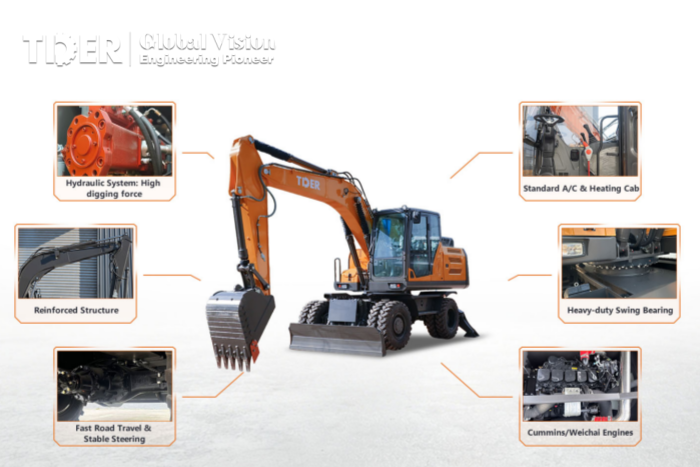
TDER offers wheeled excavator options for buyers seeking equipment for road construction and related applications. For example, the TDER TWE180 is listed as an 18-ton wheeled excavator on its product page. Buyers should verify its specifications, working range, and configuration against their project requirements before purchasing. When comparing wheeled excavator manufacturers, also consider spare parts availability, customization options, warranty coverage, and technical support. A machine that matches the actual workload can help improve productivity and manage long-term operating costs.
5. Wheeled Excavator Models Worth Considering: Specifications and Comparison
Choosing the right wheeled excavator for urban construction depends on the required digging performance, available working space, and type of work. TDER offers wheeled excavator models ranging from 7.5-ton compact machines to 40-ton specialized material-handling equipment. Comparing their specifications and configurations helps contractors identify the right machine for municipal maintenance, road construction, general excavation, or industrial handling.
The following TDER models represent different operating requirements, from compact urban jobs to heavy-duty material handling.
|
TDER Model |
Operating Weight |
Engine Power |
Key Feature |
Potential Applications |
|
TWE75 |
7,500 kg |
62.5 kW |
Compact design, dual-pump hydraulic system |
Municipal maintenance, landscaping, road repair |
|
TWE100 |
10,000 kg |
62.5 kW |
360° rotating log grapple |
Timber yards, forestry, material handling |
|
TWE120 |
12,000 kg |
74 kW |
Hydraulic outriggers, pilot controls |
Road maintenance, municipal construction, general excavation |
|
TWE150 |
15,000 kg |
92 kW |
Kawasaki positive-flow hydraulic system, full-time 4WD |
Demanding excavation, uneven terrain, road construction |
|
TWE400 |
40,000 kg |
241 kW |
Rotary orange-peel grapple, elevating cab |
Scrap yards, ports, recycling facilities, bulk material handling |
Source: TDER product pages linked below. Specifications and attachments should be confirmed for the selected configuration.
TDER TWE75: Compact Performance for Urban Projects
The TDER TWE75 is a 7.5-ton wheeled excavator powered by a 62.5 kW engine. Its dual-pump flow-merging hydraulic system is designed to improve working response and shorten operating cycles. With a standard hydraulic breaker pipeline, the machine can support municipal maintenance, landscaping, utility work, and road repair. It is worth considering for projects where maneuverability and equipment versatility are important.
TDER TWE120: A Versatile 12-Ton Option
The TDER TWE120 features a 74 kW Yuchai engine, hydraulic outriggers, and pilot controls. Its reinforced boom and arm structure supports repeated digging and loading operations. Designed for excavation, municipal construction, and road maintenance, this model is worth evaluating when a project requires more operating capacity than a compact machine while retaining wheeled mobility.
TDER TWE150: Enhanced Hydraulic Performance and Traction
The TDER TWE150 has a 15,000 kg operating weight and a 92 kW Yuchai engine. Its Kawasaki positive-flow hydraulic system is designed for responsive control, while the full-time four-wheel-drive configuration supports mobility on gravel, slopes, and other challenging surfaces. These features make it a candidate for demanding excavation and road construction where traction and hydraulic performance matter.
TDER TWE400: Heavy-Duty Material Handling
The TDER TWE400 is a 40-ton wheeled excavator designed for bulk material handling. Powered by a 241 kW Cummins engine, it features a rotary orange-peel grapple and an elevating cab for improved visibility during loading. With a maximum grapple reach of 12,260 mm, it is intended for applications such as scrap-metal handling, ports, and recycling facilities rather than typical confined urban construction sites.
Viewber and bulk material handling.
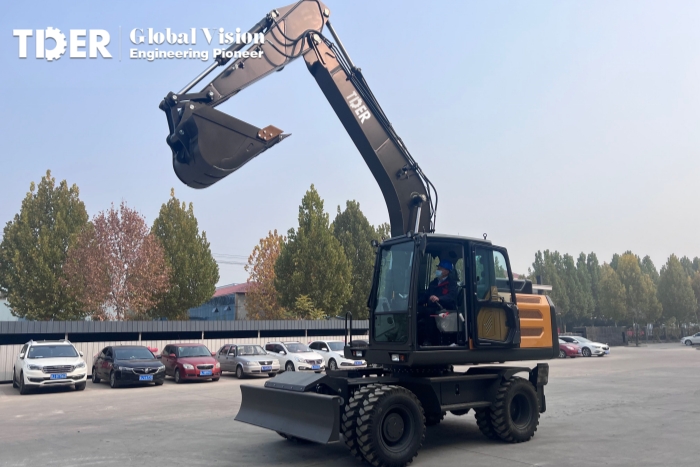
The following are the detailed specifications of the TDER TWE180 model as an example.
|
Specification |
TDER TWE180 |
|
Operating Weight |
18,000 kg |
|
Engine Model |
Cummins B5.9C54-150C |
|
Rated Power |
111 kW at 2,200 rpm |
|
Bucket Capacity |
0.8 m³ |
|
Maximum Digging Force |
100 kN |
|
Swing Speed |
0–12 rpm |
|
Travel Speed |
0–35 km/h |
|
Gradeability |
25° |
|
Maximum Digging Depth |
5,350 mm |
|
Maximum Digging Height |
8,800 mm |
|
Maximum Digging Radius |
8,363 mm |
|
Overall Length |
8,050 mm |
|
Overall Width |
2,595 mm |
|
Overall Height |
3,255 mm |
|
Tire Size |
10.00-20 |
6.TDER Wheeled Excavator: Product Specifications, Applications, and Selection Considerations
Selecting the right wheeled excavator requires evaluating machine specifications against actual job-site requirements. Key factors include operating weight, engine power, bucket capacity, maximum digging depth, working radius, and hydraulic performance. These specifications determine whether a machine can handle routine urban maintenance, road construction, drainage installation, or more demanding excavation tasks.
Different operating-weight classes serve different purposes. Compact wheeled excavators are suitable for restricted urban spaces, landscaping, and utility work. Medium-sized models offer a balance between digging capability and mobility, making them practical for municipal projects and road maintenance. Larger machines equipped with specialized attachments can handle timber, scrap metal, and other bulk materials in industrial environments.
Attachment compatibility is another important consideration. Hydraulic breakers support demolition and road repair, while log grapples and orange-peel grapples are designed for specialized material handling. Buyers should also evaluate ground conditions, transportation requirements, fuel consumption, maintenance accessibility, and local emission regulations before making a purchase.
TDER offers wheeled excavator options across several operating-weight classes, including models designed for general excavation and specialized material handling. Before choosing a model, compare the manufacturer's published specifications and confirm the required configuration with the supplier. Evaluating spare parts availability, warranty coverage, and technical support alongside machine performance can help buyers select equipment that meets project requirements and delivers long-term operational value.
7. Wheeled vs. Tracked Excavators for Urban Construction
Which Excavator Type Is Better for Urban Projects?
Choosing between wheeled and tracked excavators depends on ground conditions, site accessibility, and project requirements. Wheeled excavators are well suited to urban construction because they can travel more easily on paved roads and move between nearby job sites with less reliance on transport vehicles. They are practical for road maintenance, utility installation, landscaping, and municipal work where mobility and frequent relocation are important.
Tracked excavators, by comparison, generally provide better traction and stability on soft, muddy, or uneven ground. Their larger ground-contact area helps distribute machine weight, making them suitable for excavation on challenging terrain. However, moving tracked machines between distant sites often requires transportation equipment.
Before choosing, contractors should consider the working surface, digging depth, machine size, transportation costs, and required attachments. Wheeled excavators are often a practical choice for road-based urban projects, while tracked excavators may be more suitable for sites with difficult ground conditions. The best option is the one that matches the actual work environment and offers the right balance of mobility, stability, and operating efficiency.
8. How to Choose Reliable Wheeled Excavator Manufacturers
Choosing reliable wheeled excavator manufacturers is essential for securing dependable equipment and long-term value. Buyers should evaluate several factors before placing an order.
First, review the manufacturer's product range and technical specifications. A reliable supplier should provide clear information about operating weight, engine power, digging range, hydraulic systems, and available attachments. Detailed specifications help buyers determine whether a machine meets their project requirements.
Second, assess manufacturing capabilities and quality control. Factory information, product inspections, relevant certifications, and quality assurance procedures can help verify the supplier's credibility. Buyers should also confirm whether customization is available for specific working conditions or local market requirements.
After-sales support is equally important. Ask about warranty coverage, spare parts availability, maintenance guidance, and technical assistance. For international buyers, export experience, shipping arrangements, and communication throughout the purchasing process are also worth considering.
Finally, compare quotations carefully. The lowest price does not always represent the best value. Evaluate the machine configuration, included attachments, delivery terms, warranty, and expected maintenance costs before making a decision.
9.FAQs
What is a wheeled excavator best used for?
Wheeled excavators are suitable for road construction, municipal maintenance, utility installation, landscaping, and projects requiring frequent movement between job sites.
How do I choose the right wheeled excavator size?
Consider the required digging depth, working radius, bucket capacity, site conditions, and workload. Compact models suit restricted spaces, while larger machines handle heavier excavation tasks.
Are wheeled excavators suitable for urban construction?
Yes. Their road mobility and maneuverability make them practical for paved urban environments, especially where equipment needs to move between nearby sites.
Can wheeled excavators use different attachments?
Many models support hydraulic breakers, specialized buckets, grapples, and other attachments. Compatibility depends on the hydraulic system and machine configuration.
What should I check when choosing wheeled excavator manufacturers?
Review technical specifications, manufacturing quality, customization options, warranty terms, spare parts availability, and after-sales support.
Does TDER offer different wheeled excavator models?
Yes. TDER offers models in different operating-weight classes, including compact excavators and machines configured for timber or bulk material handling. Confirm specifications and available configurations directly with the supplier.
10.Conclusion: Choosing the Right Wheeled Excavator for Your Project
Choosing the right wheeled excavator starts with understanding your project requirements, site conditions, and performance expectations. Compare operating weight, digging range, hydraulic performance, and attachment options before making a decision. By evaluating reliable wheeled excavator manufacturers and prioritizing long-term operating value, buyers can select equipment that supports productivity and project efficiency.